EDITOR’S NOTE: For anyone who follows historian and journalist David Johnson on Facebook, his “Weird Presidential History” posts have been an ongoing treat since the November election. David knows whereof he speaks; the new editor of museum publications at the New Orleans Museum of Art also served as editor of award-winning Louisiana Cultural Vistas and KnowLA.org, the Digital Encyclopedia of Louisiana. He also serves as a board member of the (upcoming!) Tennessee Williams/New Orleans Literary Festival, and is an avid presidential history buff. “I have visited every presidential library in the National Archives system, from Franklin Roosevelt to George W. Bush, as proof!” he noted in presenting this guest essay. Fun stuff to ponder for Monday (Feb. 20), President’s Day. Enjoy.

Author David Johnson
Presidents Day offers Americans a chance to reflect upon the 43 men who have represented the nation since 1789. Louisiana has long been host to a series of events that have shaped the presidency from its earliest days. Thomas Jefferson acquired the territory that ultimately became a state in 1812. Zachary Taylor, the only Louisianian to achieve the presidency, owned a plantation north of Baton Rouge in the 1840s. A young Abraham Lincoln sailed to New Orleans from his hardscrabble Indiana family farm to make money in the 1830s. Teddy Roosevelt found the “Sportsman’s Paradise” an irresistible destination for hunting and fishing expeditions. Alarmed by the threat to Gulf birdlife, he would establish one of the earliest national wildlife refuges at Breton Island in 1904.
Franklin and Eleanor frequented the state to witness New Deal projects following the death of nemesis Huey Long. Many of John F. Kennedy’s friends — and ultimately his assassin — emerged from Louisiana. George H.W. Bush would be nominated for the office at the Superdome in 1988. Seventeen years later, his son would be harangued for failing to provide timely assisted to thousands stranded there in the aftermath of Hurricane Katrina. What follows here are a few little-known aspects of how the state has played a role in influencing the worldview of the varied men who have called the White House home.
 THOMAS JEFFERSON
Not long after Thomas Jefferson purchased the Louisiana Territory from Napoleon Bonaparte in 1803, he received word that the surprised citizens of La Nouvelle Orléans were anxious about the prospect of American rule. Among those who raised concern was Mother Superior Therese de St. Xavier of the Ursuline Convent, a nunnery that dated back to the city’s earliest French colonial founding in 1718.
In a letter dated July 13, 1804, a mere seven months after the real-estate transfer, President Jefferson assured the sister that though the U.S. would expect an unfamiliar separation of church and state in the former French and Spanish colonial city, the convent and its school would be guaranteed freedom to practice its charitable works and educational goals with no interference from federal authorities:
“To the Soeur Therese de St. Xavier farjon Superior, and the Nuns of the order of St. Ursula at New Orleans
“I have received, holy sisters, the letter you have written me wherein you express anxiety for the property vested in your institution by the former governments of Louisiana. the principles of the constitution and government of the United states are a sure guarantee to you that it will be preserved to you sacred and inviolate, and that your institution will be permitted to govern itself according to it’s own voluntary rules, without interference from the civil authority. whatever diversity of shade may appear in the religious opinions of our fellow citizens, the charitable objects of your institution cannot be indifferent to any; and it’s furtherance of the wholesome purposes of society, by training up it’s younger members in the way they should go, cannot fail to ensure it the patronage of the government it is under. be assured it will meet all the protection which my office can give it.
“I salute you, holy sisters, with friendship & respect. Th: Jeffers”
 ABRAHAM LINCOLN
In April 1828, at age 19, a lanky Abraham Lincoln journeyed down the Ohio River and into the Lower Mississippi Valley aboard a flatboat loaded with the bounty of farm products from his Indiana homeland. For young men in the early 19th-century Midwest, a riverborne escapade floating down current to New Orleans was an adventurous rite of passage and a means of putting cash in bare pockets. Continue reading
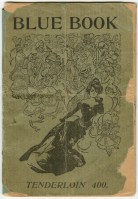 1) Storyville existed for only 20 years, and these guides (collectively called “blue books” even though they were issued under different titles) are among the few tangible relics that remain from the District. Created by an 1897 city ordinance that legalized prostitution within a geographically specified area just north of the French Quarter, Storyville operated as a thriving red light district that attracted tourists from around the country. With American entry into World War I, vice districts located near military installations were forced to close, ushering Storyville’s demise on November 12, 1917.
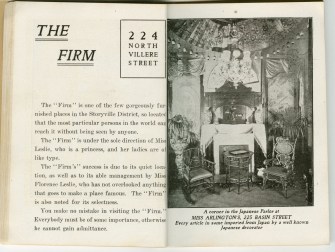 2) Advertisements for brothels in genuine blue books contain little or no reference to sex — other than “French” or “69” indicating fellatio — and do not list prices for services. In fact, brothel advertisements did not even give any real information or personal descriptions about the women who managed or worked in the brothels. Decades after Storyville’s demise, fakes and facsimiles of these prostitution guides sold to tourists traded on its bawdy legacy. These reproductions often contained raunchier language than the genuine guides and helped give rise to the misconception that the blue books contained explicit material.
 3) Numerous nationally and internationally recognized brands, including Budweiser, Pabst, Falstaff, Veuve Clicquot, Piper-Heidsieck, Mumm, I. W. Harper, Dewars, and Black and White advertised in these prostitution guides, indicating a broad reach. These advertisements, along with those for local goods and services, targeted a wealthy, white male audience, and help piece together a night in Storyville for both visitors to New Orleans as well as locals.
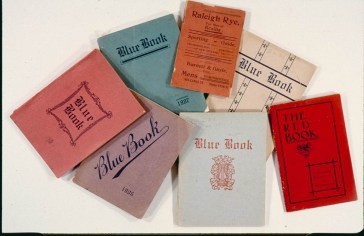 4) It is still unknown how many editions of these guides were published, or how many copies of each edition were printed. The Historic New Orleans Collection holds 24 copies of genuine guides from the Storyville-era, spanning fifteen individual editions. Our 16 copies of post-Storyville-era fakes and facsimilies represent 10 different individual editions. Together, they make up what is possibly the largest collection of New Orleans prostitution guides. Very few have survived, and examples that come on the market are considered quite rare.
 5) The “blue books” promoted Storyville as an entertainment, dance, and music venue at a time when the city was marketing itself as a winter resort, convention, and Carnival destination. This self-promotion reveals that the District and its entrepreneurs were in step with social and commercial trends that separated luxury from reality, and that the glamour suggested in its guides was part of a concentrated marketing strategy to attract upper-class white men. This marketing strategy has ensured New Orleans’ reputation as a good-time town to the present day.
 popsmartnola.com