Uncomfortably “Numb,” once again: Goat in the Road gets back in the chair

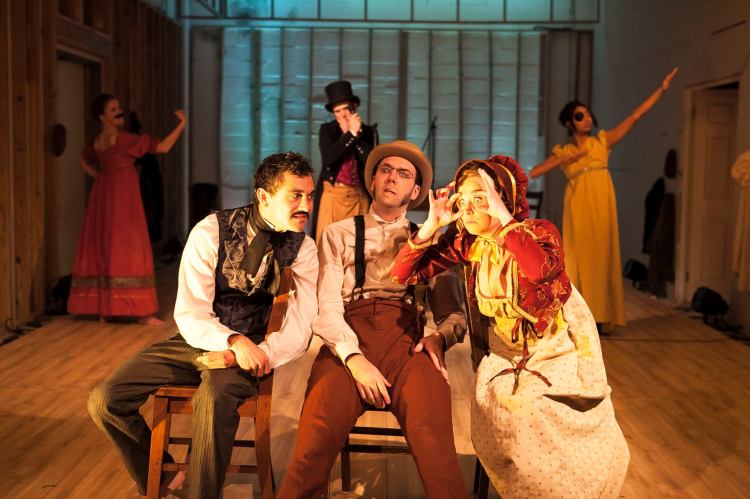
14500241_10154444151351760_8418151351694952114_o“Numb” — Chris Kaminstein directs Leslie Boles Kraus, Ian Hoch, Shannon Flaherty, Dylan Hunter, Emilie Whelan, Jake Bartush, and William Bowling
WHEN: Thurs.-Fri. (Sept. 29-30), 8 p.m.; Sat. (Oct. 1), 7 p.m. & 10 p.m.
WHERE: Catapult Performance Space (609 St. Ferdinand St.)
TICKETS: $15 general admission, $10 students
INFO: Visit the Facebook event page

I was always bummed I didn’t get “Numb” after interviewing Goat in the Road Productions’ Chris Kaminstein back in 2014 when the theater company presented this examination, so to speak, of all things pain management.

Fortunately, the show is back for an encore performance, relaunching last weekend and, following its run in the Catapult Performance Space (609 St. Ferdinand St.), will hit the road later this fall for a U.S. tour.

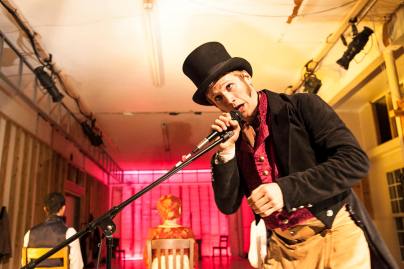
14290045_10154399846036760_1324648673572932237_oThe production, which won Big Easy Awards for Best Ensemble, Sound Design (Kyle Sheehan) and Original Work-Devised, is serving to kick off Goat in the Road’s 2016-17 season, though without original cast members Francesca McKenzie and Todd D’Amour (we miss them!). The work takes a look at early 19th century attempts at pain-free surgery, as well as “the ecstasy and intoxication of drugs that alter human consciousness, and the often-forgotten human stories that accompany advancement.”

It was a truly collaborative effort, director Kaminstein told me, in which the company partnered with the Pharmacy Museum as well as the Cachet Artist Residency Program to bring together experts in the field, as varied as Dr. Harry S. Gould, professor of Neurology and Neuroscience at the LSU Pain Mastery Program and a Cajun healer. The inspiration:

Goat in the Road has spent a couple of shows looking back at history to mine for interesting artistic material. One of the things I love realizing (over and over again), is that inventions we take for granted, like getting knocked out for surgery, have human complication attached to them. When nitrous oxide and ether were first being used in dental surgery in the mid-19th century, there was a tremendous battle between three men for the claim of being “first” to try it. Each man, over the course of 10 years or so, was destroyed by this fight in different ways. In “Numb,” you will see the story of Horace Wells, one of the first to try nitrous in dental operations, and his steady decline and eventual addiction to chloroform.

I’m planning to attend this evening’s performance and will share my thoughts soon after. Visit the Goat in the Road website for the rest of the 2016-2017 season.


Playwright Gabrielle Reisman’s Top 5 influences for “Flood City,” opening The NOLA Project’s 2016-17 season

This slideshow requires JavaScript.


“FLOOD CITY”
WHAT: The NOLA Project presents its 2016-17 season opener, written by Gabrielle Reisman, directed by Mark Routhier, and starring Ashley Ricord Santos, Keith Claverie, Amy Alvarez, Trey Burvant, Ian Hoch, Jessica Lozano, Matthew Thompson
WHEN: Thurs.-Sat. (Sept. 1-3), 8 p.m.; Sun. (Sept. 4), 2 p.m.; through Sept. 17
WHERE: New Orleans Center for Creative Arts (NOCCA), 2800 Chartres St.
TICKETS: Thursdays and Sundays: $30 general admission & $20 for NOLA Project Backstage Pass Members. Fridays and Saturdays: $35 general admission & $25 for NPBPM. Purchase online at www.nolaproject.com or by calling 504-302-9117.

“Flood City” already was remarkably timed as The NOLA Project’s 2016-17 season opener, what with its proximity to the 11th anniversary of Hurricane Katrina. The recent floods in Louisiana — first in March, in north Louisiana, and the a couple weeks ago in south Louisiana — make playwright Gabrielle Reisman’s world premiere feel downright prescient. But as with lots of productions, there’s a lot more to “Flood City” than just water, as we’ll learn from Reisman after requesting her influences for this work — her third produced by The NOLA Project, which mounted “Taste in 2009 and Catch the Wall” in 2013. This production is directed by Mark Routhier. Here’s what Reisman had to say about it:

“Flood City” charts the wake of The Johnstown Flood of 1889. The flood has destroyed the bustling steel town of Johnstown, Penn., and left a motley crew of survivors and surveyors to clean up and rebuild. Meanwhile, at a bar in Johnstown a century later, laid-off steel workers wax metaphoric about past lives and future ambitions. Traversing time and space, the play is an all-too-apt mirror of our present times. It takes a darkly comic look at both the lunacy of rebuilding and the strength it takes to clean up and start over.

Though I watched a fair amount of Johnstown Flood documentaries, 1980s country music videos and revivalist church services in writing this play, these five videos most influenced the dark-hopeful magic I was trying to build in “Flood City.”

“Telephone,” Lady Gaga — These U.S. soldiers in Afghanistan’s version of Lady Gaga’s “Telephone” may be my favorite thing on the Internet. I love the combination of completely earnest choreography and fabulous DIY costumes against the intense polish of the pop music. Add to this the fact that it was made in the strange anti-space of an occupying army base in a war zone. It’s more Dadaist than anything Lady Gaga herself could dream up. “Flood City” is about a bunch of folks making something out of nothing in the midst of disaster. It employs a similar sense of play and peril. A man moves nonchalantly through the wreckage with a pipe sticking out of his head. Two women sell bits of broken flood relics to first responders. There’s a blitheness-of-necessity inside the catastrophe.

“Don” — I’ve been enamored with the 1978 Bollywood film“Don” since I was in high school. “Don” follows a charismatic crime boss (Don), the woman who wants to see him dead, the man who begins impersonating him, and their complicated romance. I’ve spent years looking at Bollywood songs from this period because they usually involve a character singing a secret to the person the secret’s about. The person they’re singing to can totally hear the words, but it’s as if the song takes place in some sort of breakaway dream moment. When it’s over, we as audience know more about the person singing and their secret intentions, but the person who heard the song is none the wiser. In this song, the man impersonating Don is telling Don’s criminal brethren he’s not who they think he is and he is tricking them all. You can read a weird translation of it here. In “Flood City,” and in all my plays, I’m interested in the moments where characters casually break the fourth wall and the ways giving an audience secret knowledge invests them in the world. There’s also a lightness/sharpness/silliness to this video that I love so hard. We’ve been playing with that same light/sharp/silly combo as we put the play on its feet.

“Get Into the Groove,” Madonna — In “Flood City,” the survivors of the Johnstown Flood live onstage simultaneously with a dive bar of newly out-of-work steel men in 1992. When I was figuring out how these two times intersected in the play, I was listening to a lot of pop and country songs from the late 1980s and early ’90s. Writers do this sort of lucky-socks thing where we’ll hear a song that makes us see something new about our play then we obsessively listen to it on repeat like its a portal for all of our play’s secrets. Madonna’s “Get Into the Groove” was this song on this play. The upbeat call to dance was somehow the perfect discordant window to these jobless, uncertain steel men.

“Funnel of Love,” Wanda Jackson — This song makes me swoon every time I hear it. It’s sexy and a little scary. There’s queerness and down-the-rabbit-hole quality to the song that I dig so much. While “Get Into the Groove” feels like the way 1992 operates inside a story about folks in 1889, “Funnel of Love” is the way these two times are dancing up on each other: an off tempo two step between different disasters a century apart.

“Tambourine Praise,” Jacolby Parker — “Flood City” skirts a little with miracles and faith. I spent a lot of time parsing through spirituals of the late 1800s, as well as the ballads and parlor music that was written about the Johnstown Flood itself. In the end, though, the thing that spoke to me most were Baptist tambourine breaks, and the sermons that lead right up to these breaks. Of all the videos I watched, and even of my memories visiting Franklin Avenue Baptist Church in the 1990s, this post by Jacolby Parker gets me the most. It is so simple and so personal and so skillful. I wanted to touch on the hope inherent in rebuilding and the way we have to give ourselves over sometimes to a higher power — the rigor and joy it takes to let go and move forward.


Bunny Love’s top 5 (or so) influences to prep for “The Killing of a Lesbian Bookie”

Killing of a Lesbian Bookie

Bunny Love as Triple Lexxx. (Photo by Edward Simon)

WHAT: “The Killing of a Lesbian Bookie,” written and directed by Jim Fitzmorris and starring Bunny Love, Justin Welborn and Kimberly Kaye
WHEN: Thursday-Saturday (June 30-July 2), 8 p.m.; Sunday (July 3), 6 p.m.
WHERE: The Theatre at St. Claude, 2240 St. Claude Ave.
TICKETS: $25
MORE INFO: Click here

To say that Bunny Love is a woman under the influence in Jim Fitzmorris’ “The Killing of a Lesbian Bookie,” which concludes its two-weekend run starting Thursday (July 30) at The Theatre at St. Claude, would be a massive understatement. Like the playwright himself, Bunny Love brings myriad influences to a story whose title is lifted from director John Cassavetes’ arthouse noir classic. (I noted as much in my review of the playI noted as much in my review of the play.) To get a sense of this, and how Bunny Love tapped into her own vast background as a burlesque performer, I asked her to share those influences.

“Dracula” was the first play I had done in a while and my introduction to the New Orleans theater scene after moving back here from New York City in 2014. We performed the last two weekends in October — perfect for Halloween. It was a short, intense rehearsal, as I have now learned, the only kind of (Jim) Fitmorris rehearsal. I was thrilled to be doing a play and even more thrilled to be working with Matthew Mickal, Joel Derby, Kimberly Kaye, Trey Lagan and Jim Fitzmorris. I fell madly in love with everyone involved! I’d been hit by a car on Oct. 8 while riding my bike in Audubon Park and broke my left wrist in three pieces. I could have felt sorry for myself and gotten depressed, but this show, with these people, saved me from that. At the end of our run, Jim had a light-bulb moment and realized Kimberly Kaye and I were the two actresses he’d been seeking for his play “The Killing of a Lesbian Bookie,” a play he’d written in early 2013. He’d always had his college buddy, L.A.-based actor Justin Welborn, in mind to play Irish, but couldn’t find the right fit for the two female characters: Triple Lexxx, the burlesque star about to open her own club, and Bookie, her wise-rackin’ “Fake-O tough guy” girlfriend. When I took Jim’s script home and read it, it was like he’d written it for me! I was a little freaked out. Justin and Kimberly (who was living in New York City, but recently moved here) were able to come to New Orleans in November for a reading. Sparks were flying from that first table work. We were titillated with excitement. We decided we would do the show in June. Justin arrived on the night of the 13th, and we went to work. Long, intense, eight-to-nine-hour rehearsals with people I love and admire is pure joy for me! We opened the show on the 23rd. It all came together with “hard work and hustle,” and a lot of theatrical magic. The show is a blast — three damaged human beings looking for redemption, spitfire dialogue, and a twisting plot that will literally keep you on the edge of your seat. I did some very specific work to prepare for this play. Here are some of my inspirations.

John Cassavetes — Filmmaker, actor and just my type of man, intensely sexy and infinitely cool. Like my character, Triple Lexxx, I “love all Cassavetes.” After our initial table work, I had a Cassavetes move marathon. I spent days watching everything: “The Killing of a Chinese Bookie,” “Shadows,” “Faces,” “Husbands,” “Minnie and Moskowitz, “A Woman Under the Influence,” “Gloria,” and “Big Trouble.” I think I missed one or two. Falling in love again with the man and his movies, his “gritty American realism,” and how it related to “The Killing of a Lesbian Bookie.” Cassavetes presented difficult, flawed characters in disturbing situations delivering clever dialogue one might hear at a cocktail party gone wrong. It was helpful to steep myself in that world. There is a particular feeling in all of Cassavetes’ work, and that feeling is there in “The Killing of a Lesbian Bookie.” Irish, Lexxx and Bookie, all with their faults and dark secrets in a frightfully tense situation with crisp dialogue that sometimes erupts into shouting. I never met Cassavetes, but I did have a “next best thing” moment when I met Ben Gazzara at a film festival in New York City and had a mini-makeout session as I was putting him into a cab at the end of the night. Yum!

All the movies mentioned in “The Killing of a Lesbian Bookie” (in addition to Cassavetes) — “The Friends of Eddie Coyle,” “The Town,” “Frankenstein,” “The Godfather,” “Guys and Dolls,” “Chinatown” and “The Count of Monte Cristo.” I needed to understand the references to these movies, but I also found a love and appreciation for these beautifully constructed films, most of which I would have thought aren’t really my thing, but found myself riveted. Like Irish and Lexxx, I also love movies, and it was just great to be reminded of that. These films are also full of characters, situations and dialogue that related to life and informs “The Killing of a Lesbian Bookie.”

Barbara Stanwick (specifically in “Baby Face”) — this is a wonderful character study of a woman who knows how to use what her momma and daddy gave her to get what she wants. It’s super racy for 1933! She is always in control of herself and her situation — well, until the tragic end. I tried to take on that strength and control. I even stole a few facial expressions and gestures. She’s a woman on her way to the top. She knows what she wants and she will do whatever it takes to get it. She’s scrappy and comes from the wrong side of the tracks, but has groomed herself to hide all that. Triple Lexxx is also all of those things.

Lauren Bacall (specifically in “The Big Sleep”) — She is know for her cool demeanor and unflappable poise. I think Lexxx made a study of her and wanted to be that cool. I studied her posture and her stillness; she hardly ever moves her shoulders. It’s incredible and so powerful, and her hands, her beautiful hands! Another piece of candy from this movie was the way she and Bogart flirted, the cat and mouse, the wordplay. They are the best. We strive for something like that in our play. Finally, it was the love between Bogart and Bacall. You could feel her love for him. I wanted that for Lexxx: a true love. I want the audience to see that in my eyes.

My own life and various burlesque performers, strippers and sex workers I am friends with or have known — One of the first things you do as an actor is look for the connective tissue between yourself and the character. Luckily, I had so much to draw on, not that it’s the same, but that it’s relatable or easily substituted. Of course, there’s my long career in burlesque, but I had also fantasized about opening a burlesque club here, before I moved back, so I already knew what it looked like. I also used pieces of women I know, their lives, their personalities. So many influences, both good and bad, but I don’t want to incriminate anyone so I’ll just give you a few examples: From my BFF, my wife, Bambi the Mermaid, I used her incredible ability to manifest exactly what she wants in life. From Julie Atlas Muz, I got her Detroit toughness. Julie is a lovely, sweet person, but definitely the lady who can take care of herself. From Dirty Martini, I borrowed her undying passion and pure love for burlesque, performing and entertaining.

With “The Killing of a Lesbian Bookie,” Jim Fitzmorris plays all of his angles

4-001

Photo by Edward Simon

WHAT: “The Killing of a Lesbian Bookie,” written and directed by Jim Fitzmorris and starring Bunny Love, Justin Welborn and Kimberly Kaye
WHEN: 6 p.m. Sunday (June 26); Thursday-Sunday (June 30-July 3)
WHERE: The Theatre at St. Claude, 2240 St. Claude Ave.
TICKETS: $25
MORE INFO: Click here

Jim Fitzmorris wears his influences on his sleeve. Or, in the case of “The Killing of a Lesbian Bookie,” on his plays’ title, and on the spare stage of his latest work that opened this weekend at his Theatre at St. Claude. Movie posters of “The Friends of Eddie Coyle” and rows of DVDs from The Criterion Collection fill the stage and prompt snippets of dialogue from the characters, but clearly they’re laid bare as if transported from Fitzmorris’ home, or brain.

So when smooth-talking and wise-cracking beverage vendor (Justin Welborn) shows up on the soft opening of a nightclub venture and starts flirting with the co-owner and featured performer (Bunny Love), their shared of love of ’70s crime films by Cassavetes, Polanski and Coppola, the audience immediately knows that this is Fitzmorris at his most reverential and referential. But almost as immediately, as a flirtation turns to threats and then into terror and then into intrigue and possibly back again, the audience also recognizes another Fitzmorris passion: complexity. It’s the complexity of motivations, of desire and even of language that often motors Fitzmorris’s works, and while they’re often challenging to follow, they’re always worth the ride.

“The Killing of a Lesbian Bookie” is an uptempo and bumpy ride in which allegiances switch with every “reveal,” a popular word in a show and with burlesque undertones. (Fitzmorris, also a frequent chronicler of New Orleans’ burlesque scene, knows this as well as he does movies.) As the co-owner of the Triple Lexxx club, Bunny Love can practically live the role, having performed for several years in New York City’s gritty neo-burlesque scene. She returned to New Orleans a couple years ago, bringing her New York sensibilities to shows such as Bella Blue’s “Dirty Dime Peepshow” while increasingly elevating her theater profile. So when she recounts a seedy story of life as a stripper, as with Fitzmorris you almost want to believe it comes from her own experiences. But you can’t dwindle on the thought for very long in this 70-minute one-act play. The action’s too fast.

The play starts off with Lexxxi ready to open her nightclub, for which she’s scrimped and saved to open and make her meal ticket after years in the business, with the help of her lover (played by a twitching Kimberly Kaye). Those plans are compromised by the appearance of Irish, who presents himself as the beverage supplier for the club, and the two strike up a conversation that goes beyond business.

It’s just when Irish senses Lexxxi’s loyalty to her partner has its own motivations that he reveals (at least one of) his own after a frantic phone call from her partner, a part-time bookie who warns Lexxxi that Irish has come to kill her. Hanging up the phone, Lexxxi can only keep her poker face for so long before Irish explains his presence:“Bookie” owes debtors for huge gambling losses built on Lexxxi’s money. But he tries to calm her down with the slightly reassuring thought: “I’m the second-to-the-last person you want to see. … In politics and crime, there’s always a second-to-the-last-guy.” Lexxxi, twisting around their previous flirting, responds, “You watch too many movies … so you’re Tom Hagen (of ‘The Godfather’ fame)?”

Irish offers a proposal — more a less-worse option — in which Lexxxi signs the club over to him so he can gain control of it (and Lexxxi) to help pay off the debt as long as Bookie disappears.

A tight cast makes great work of a tight though sometimes dense script, with Justin Welborn (FX’s “Justified”) bringing a pitch-perfect mix of cynicism, swagger and a sliver of vulnerability to his role. He could either try to dominate the stage as the lone male character or get lost in a lover’s quarrel, but he does neither, and it’s a neat trick. It is only fitting that his character once was an aspiring movie mogul, playing on Welborn’s own movie experience. And Kaye’s nervous intensity crackles throughout the show, even at times drawing in the audience’s sympathy with her own vulnerability. Through her desperation we still see another soul trying hard, like the others, not to be lost. If they all need a few moments in the early going to get their footing with the script, they all hit their stride quickly enough.

They do this just in time for a cleverly conceived passage in which exposition is revealed in a three-way dialogue between them, told partly in present time and also in flashback, with each character alternating in filling in the holes. It’s all wordplay as gunplay, of which there’s plenty already.

So much about “The Killing of a Lesbian Bookie” is about control, which makes it that much more interesting when Lexxxi explains why she favors burlesque over stripping: “Because it gives the illusion that the audience is in control … the only decisions are mine.” Once every character has explained their angle in this love triangle, it’s Lexxxi’s call.

Jim Fitzmorris bills the play as his first full-length piece since “A Truckload of Ink,” which he followed up with such works as his brilliant manifesto-monologue, “Be a New Orleanian.” He’s found a home for his works at The Theatre at St. Claude, with an intimate space that David Raphel makes great use of in his set design. Su Gonzcy works the lighting deftly in what amounts to two adjoining rooms, and Dana Marie Embree’s costumes blur the lines between the ’70s and the present day.

And yet, watching this compressed treat, I can’t help but wonder if “The Killing of a Lesbian Bookie” could be something a little grander — like, say, a burlesque musical where Lexxxi’s dreams of a fabulous nightclub come to life, with music and dance numbers as eloquent as Fitzmorris’ rapid-fire dialogues and monologues. That’s not so much a criticism as a wish. This work is already more fully realized in narrative structure and prose than its casual inspiration, John Cassavetes’ 1976 arthouse noir, “The Killing of a Chinese Bookie.” As good as this play is, you sense the possibilities of something even grander.

I guess that’s the point of burlesque: Always leave the audience wanting more.

See ’Em On Stage announces 2016-17 season along with expanded programming, restructuring (exclusive)

This slideshow requires JavaScript.

See ‘Em On Stage, the nearly three-year-old New Orleans theatrical company known for its passion for offbeat musical satire, announced a 2016-17 season fueled by a management restructuring and other changes during its “Rebel Rebel” premiere party Tuesday (May 31) at the Ugly Dog Saloon.

“This new model will allow us to offer opportunities to a wider variety of artists including local writers, directors, actors, designers, dancers, musicians, and theater educators; along with visual artists (for special projects),” Artistic Director Christopher Bentivegna said in a press release. “Our team now includes 16 diverse theater professionals working together in order to provide a multitude of projects within seven different divisions.”

That team will feature Bentivegna along with Kali Russell (associate artistic director), Bob Murrell (managing director), Breanna Beitz (managing director), Jake Wynne-Wilson (community outreach coordinator), Ashton Akridge (burlesque division coordinator), Kayln Hepting (staged readings division coordinator) and Abbey P. Murrell, Caroline St. Amant, Eli Timm, Clayton Shelvin, Anna Toujas, Robert Young, Logan Faust, Rebecca Lindell, Ariel Schwab, and Sam Cespedes.

(Read more: Christopher Bentivegna’s Top 5 favorite See ’Em On Stage productions)

New divisions to accompany the company’s main-stage productions include original works, burlesque, comedy, staged readings, community outreach and youth education. The new season also will bring on new venues such as the New Orleans Art Center, The Avant-Garden District, and The Valiant, a new theater opened by Richard Mayer — formerly of the Old Marquer Theatre. (This new theater is scheduled to open in July, the release said.”

See ‘Em On Stage already has presented work that reflects this new approach, the release said, noting the production of original short plays as part of its community-outreach program for patients and clients at both Children’s Hospital of New Orleans and Crossroads Louisiana (which services adults with disabilities). The company plans to partner with The New Movement for a program for teens to perform in a full one-act production at program’s end.

The company also has brought in Four Sweater Vests, the local staged-readings company, as one of its official divisions “with a mission to provide opportunities to both experienced and novice performers and directors through participation in staged readings of popular works.”

“This new model of different divisions will allow us to not only offer more opportunities to established as well as fledgling artists, but will provide us and the theater community in general with a more diverse and wide-reaching audience base,” the release said.

The 2016-17 main stage season will offer a schedule that speaks to the “Rebel Rebel” theme that explores the notions of heroes and anti-heroes, and will include three regional premieres and one New Orleans premiere. (Synopsies provided by the company.)

Lizzie the Musical
Written by Steven Cheslik-deMeyer, Tim Maner and Alan Stevens Hewitt
Aug. 11-28, 2016 (Thursdays through Sundays, 8 p.m.) except Aug. 13 (9:30 p.m.)
New Orleans Arts Club
Synopsis: “Four women front a rock band and tell the scandalous story of Lizzie Borden, America’s favorite double-axe murderess and Victorian hometown girl. In 1892, on a sweltering August day in a small New England town, a well-to-do elderly man and his second wife were brutally murdered with an axe in broad daylight. Lizzie Borden, their youngest daughter, was the primary suspect. She was arrested and tried, but, with no witnesses to the hideous crime, she was acquitted. The murders remain unsolved to this day and have become not only one of America’s most notorious legends but also the inspiration for this critically acclaimed new musical. This nearly sung-through rock opera’s score owes less in inspiration to Andrew Lloyd Weber or Stephen Sondheim than it does to Heart, Nirvana, Led Zeppelin, The Beatles, and Grace Slick. Starring Abbey P. Murrell, Idella Johnson, Kali Russell, and Leslie L. Claverie as Lizzie Borden. This production will be a regional premiere.” Continue reading

Christopher Bentivegna’s Top 5 favorite productions by See ’Em On Stage

This slideshow requires JavaScript.

INFO:
WHAT: “REBEL REBEL!”: See ’Em On Stage season announcement party
WHEN: Tuesday, May 31, 7 p.m.
WHERE: Ugly Dog Saloon, 401 Andrew Higgins Drive
TICKETS: $12 advance, $15 at the door
MORE: Visit www.seosaproductioncompany.com or here.

Under the supervision of Christopher Bentivegna, See ’Em On Stage has been a welcome new addition to the New Orleans theater scene at a time when we’re seeing fewer of them around. In advance of the production company’s 2016-2017 season announcement (7 p.m. Tuesday, May 31, at the Ugly Dog Saloon), we asked Chris to provide his five favorite productions.

In only two and 1/2 years, See ’Em On Stage has made quite a splash. And sometimes a bloody one. During this time, we have presented shows of various styles, from campy blood-splatter musicals to original works to a melodramatic world premiere stage production of an internationally known best-selling novel. Our productions have starred some of New Orleans’ finest singers and actors and even one multiple Tony Award-winning actor. Every production challenged us in new ways and drew in diverse audiences. Our goal, when we began, was to provide theatrical experiences akin to what New Yorkers are able to get when they venture to off and off-off Broadway shows. Every one of our mainstage productions has been New Orleans premieres and a few were world premieres where we worked directly with the writers. It is difficult to pick a “Top 5,” but the following represents the evolution of our company and the bold work we have shared with our audiences.

EvilDeadcast.Marcia Arceneaux

“Evil Dead.” (Photo by Marcia Arceneaux)

5) “Evil Dead: The Musical” — “Evil Dead” was the musical that started it all! Challenged with a script that glorifies blood splatter and gore, we focused on the heart of the musical and it was directed more in the style of a musical like “Hairspray.” I encouraged the actors to find the truth in all of their cartoon-style characters, and it was choreographed (Lindsey Romig) and musical-directed (by our multiple Big Easy Award nominated musical director Natalie True) in a bubbly, upbeat way. Right before we started rehearsing with the blood, I told the cast, “We are going to take this bright, polished, buoyant musical that we have created and we are going to crap all over it with blood.” Audiences were immersed into the action and gore by becoming part of the experience as blood was rained all over them. The show was not only a commercial success, but it was also a surprising critical one as well, garnering rave reviews from the local press and receiving multiple Big Easy Award nominations including Best Musical of the Year. It went on to win the award for Best Actor for Robert Facio’s spot-on performance as the demon-killing Ash. We would go on to produce two more blood-splatter musicals: “Musical of the Living Dead,” which was based on the classic zombie horror film “Night of the Living Dead” (and which featured more than twice the blood of “Evil Dead”), and “A Christmassacre Story,” which was a devised work (featuring puppets!) written by the talented Kimberly Kaye and starring Michael Cerveris — who only a few months later went on to win his second Tony award for his critically acclaimed performance in “Fun Home.”

Zanna Don't.Michael Clark

“Zanna Don’t!” (Photo by Michael Clark)

4) “Zanna Don’t!”  Our follow-up to “Evil Dead” could not have been more different. It was a musical that celebrated diversity and glorified everything sparkly and bright. Glitter and be gay! We assembled an amazing cast with some of the most beautiful voices in New Orleans. The Big Easy Award-nominated choreography by Lindsey Romig was astounding, particularly given the constraints she faced in the tiny Old Marquer blackbox theater (still The Shadowbox at the time). The story of a reverse world where being gay is normal and being straight is frowned upon, was embraced by audiences and critics and showed a softer, more gentle side of our company while exuding our previous aesthetic of taking risks and finding the true heart in the material. It, too, went on to garner a myriad of Big Easy Award nominations with Joshua Brewer winning Best Actor for his touching portrayal of the title character.

A New Brain

“A New Brain.” (Photo by Audion de Vergniette)

3) “A New Brain”  This was our first show that we produced outside of The Old Marquer. It was a co-production with Chris Wecklein’s (who also starred as Gordon) company Some People, LLC, and also starred Tracey Collins and Jessica Mixon in their Big Easy Award nominated performances. It was a challenging show, and we were presented with an even bigger challenge with our venue, Kajun’s Pub. This little-known, off-Broadway show was a tough sell as a musical about a man who was suffering a life-threatening brain disorder. In addition, the show is not told in a typical straightforward, linear way. It required actors who could not only handle difficult vocals (made easier by our talented music director Ainsley Matich) but who could also bring these characters to life in a way that would help provide a clearer understanding of the non-traditional storytelling to the audience. We were honored to work with some of the city’s finest performers in this show, and everyone handled his or her own role with aplomb, developing rich and memorable characterizations and stopping the show with gorgeous vocal performances. The challenge of staging and choreographing (choreography by Amanda Zirkenbach) the show in a bar was actually one of the most exciting and rewarding things about the experience. We embraced the entire space and completely immersed the audience in the world of these rich characters, telling their story with reverence, love, heart and music.

Flowers in the Attic.Christopher Bentivegna

“Flowers in the Attic.” (Photo by Christopher Bentivegna)

2) “Flowers in the Attic”  “Flowers in the Attic” was unique for many reasons. It was our first non-musical, and the first time the story, based on the best-selling novel by VC Andrews, was ever presented theatrically. We were honored to be chosen as the first production company in the world to present this beloved and controversial story, and the experience was made better by being able to work directly with the playwright Andrew Neiderman. Mr. Neiderman, known for his best-selling novel “The Devil’s Advocate,” took over writing for VC Andrews as her ghostwriter following her death in 1986 and has sold tens of millions of copies of his books under both names. The book, banned from many school libraries, was a favorite of mine since I was a child and as a senior in high school I had written, produced and directed my own one-act version for my senior drama class project. It felt fated that I would have the experience to be the first producer and director in the world to tackle this piece in its official world premiere. Dealing with themes of child abuse, betrayal, greed, incest, and murder, the play was particularly challenging in its casting. Not only did the actors have to very specifically resemble the characters that were known from the book and two movie adaptations but two of them had to be young children (under the age of 10) who could pass as twins. The cast not only handled the material with skill but also with great sensitivity as well. Each actor created a beautiful, tragic and sympathetic character and the entire cast developed electrifying chemistry. The entire experience was heightened by an effectively chilling set (Matthew Collier with Rebecca Lindell) that transformed the entire black box of The Old Marquer into the attic itself with the audience becoming “trapped” in there alongside the characters. The show went on to become an unexpected commercial and critical success and was recently awarded with multiple Big Easy Award nominations.

Terminator.Brian Jarreau

“Terminator.” (Photo by Brian Jarreau)

1) “Terminator The Musical”  “Terminator” may have been the biggest surprise of our short history as a theater company. Written by local writer, Breanna Bietz, the show received its world premiere as part of the Faux/Real festival in the fall of 2015. Ms. Bietz approached us after seeing our production of Musical of the Living Dead about potentially producing her work. Seeing an aesthetic that she felt matched the tone of her writing, she pursued what eventually became a symbiotic partnership. We recruited the creative and energetic Cammie West to co-direct (which helped us greatly since we were doing one show overlapping with another at the time) and found a cast of sexy, talented, and devoted actors and singers. What made the show so special was the special collaboration that formed between us all. The play itself went through a variety of rewrites and concepts and each actor was able to give input into the development of his or her character. The “orchestral music” was 100-percent electronic, which gave the whole production a high-energy and modern feel. The intimate space of The Old Marquer was a perfect complement to this fast-paced, tight and seductive show. Audiences embraced the show, with lines out the door and one standing room only performance after another. Critics also embraced the show, impressed with the ingenuity and creativity of the production and the talent and charisma of the cast. We were honored to receive several Big Easy Award nominations for the production and were thrilled to perform one of the best songs from the play, “Programmed to Kill,” at the awards show this past April.


For The NOLA Project’s 12th season: Survival of the fittest

Season12_Announcement2.jpgThe NOLA Project recently announced its 2016-17 season, with the theme of “Survival.” Often topical, sometimes irreverent and almost always excellent, The NOLA Projects offers some of the most consistently compelling productions in New Orleans.

This season, according to a press release, will feature world and regional premieres along with a Broadway comedy. Here’s the rest of the release in full. I’ll have more thoughts later:

“We open the 2016-17 Season with the World Premiere of FLOOD CITY by Gabrielle Reisman.Award-winning director Mark Routhier (Marie Antoinette and One Flew Over the Cuckoo’s Nest)will bring to life Reisman’s striking and quirky story that examines the working class residents of Johnstown, Pennsylvania during both the famous Johnstown Flood of 1889 and in the midst of the steel mill closures of 1992. Traversing time and space, Reisman’s distinct magical realism infuses the words and stories of these distinctly American workers who, more and more it seems, are fading into total extinction. FLOOD CITY will run September 1-18, 2016 at NOCCA’s Nims Black Box Theatre.

Next is the Regional Premiere of the new Pulitzer Prize-nominated play 4000 MILES by Amy Herzog. This hilarious and heartbreaking new work tells the story of a young man seeking solace from his feisty 91-year-old grandmother in her West Village NYC apartment after a lengthy and painful cross-country trip on his bicycle. The New York Times called the original production, which starred New Orleans local Mary Louise Wilson, “a funny, moving, and altogether wonderful drama.” Stepping into the roles of grandmother Vera and grandson Leo are New Orleans stage luminaries Carol Sutton and James Bartelle. They will be directed by Big Easy Award-winning director Beau Bratcher. 4000 MILES will run October 20-November 6, 2016at a location to be announced.

In January, The NOLA Project will partner with Delgado Community College for the first time ever to present a massive co-production of John Steinbeck’s THE GRAPES OF WRATHadapted by Frank Galati. The play will be the first professional production to appear in the brand-new Delgado MainStage Theater and will feature a cast of over twenty actors, directed by NOLA Project Ensemble Member Jason Kirkpatrick. Through beautiful staging and story-theatre techniques, the ensemble will bring Steinbeck’s classic tale of the Joad family to life as they pile everything they own into a battered old truck and head west to California in the desperate hope for work and a living wage. Chicago’s Steppenwolf Theatre Company premiered the epic stage work in 1991 where it transferred to Broadway and won the Tony Award for Best Play. THE GRAPES OF WRATH will run January 26-February 12, 2017.

May 2017 brings the annual return to the New Orleans Museum of Art’s Besthoff Sculpture Garden with the World Premiere of THE SPIDER QUEEN by NOLA Project Ensemble Members James Bartelle and Alex Martinez Wallace. In this imaginative new play, two teenage siblings become lost in the woods and encounter a kingdom in peril, filled with fantastical creatures, nefarious villains, and the giant Spider Queen who has been frozen by a sorcerer’s curse. Like “The Goonies” meets “The Chronicles of Narnia”, THE SPIDER QUEENintends to awaken the adventurous spirit in us all as the audience travels through NOMA’s Sculpture Garden and the young heroes befriend elves and trolls, battle ogres, and learn lessons of courage, kindness, self-sacrifice, and finding direction without a smartphone. Big Easy Award-nominated director Jon Greene will helm the production.

And to end the season in a big way, we are teaming up on our first-ever co-production with Le Petit Theatre du Vieux Carre to present the hilarious love letter to theatre IT’S ONLY A PLAY by Terrence McNally. It’s the opening night of THE GOLDEN EGG on Broadway and the wealthy producer Julia Budder is throwing a posh party in her lavish Manhattan townhouse. Downstairs the celebrities are pouring in, but the real action is upstairs in the bedroom where a group of insiders have staked themselves out to await the reviews. Will it be the massive flop to end their careers or the greatest new American play of this century? Only The New York Times will tell. NOLA Project Artistic Director A.J. Allegra will direct a cast of New Orleans all-stars including Ricky Graham, Sean Patterson, Leslie Castay, Cecile Monteyne, James Bartelle, Keith Claverie, and Alex Ates. IT’S ONLY A PLAY will run June 8-25, 2017 at Le Petit Theatre.

“This season we’re exploring what it means to be an American,” says NOLA Project Artistic Director, A.J. Allegra. “We are in a fight for our national existence. In every facet of American culture, there are battles for agency and recognition from different races, genders, and other groups and we see this in the American Theatre just as strongly as we see it in our politics. For our 2016-17 Season we chose stories that reflect that sentiment and cause us to start meaningful dialogue with one another rather than divisive argument.”

“Black Angels Over Tuskegee” offers history lesson at WWII Museum this weekend

Photographer: Grace Finlayson '17

Photo by Grace Finlayson

INFO:
“Black Angels Over Tuskegee”
7:30 p.m. Fri.-Sat., 1 p.m. Sun.
Stage Door Canteen, National World War II Museum, 945 Magazine St.
$65 for dinner/brunch and show; call 504-528-1943 or visit the ticket link

Back when he was in his 30s, Alexandria native Layon Gray was channel-surfing on the couch of his Los Angeles home in 2007 when the actor and playwright ran across a C-SPAN airing of the aging Tuskegee Airmen receiving the Congressional Gold Medal from President George W. Bush.

“Wow,” he recalled thinking, “this is incredible!”

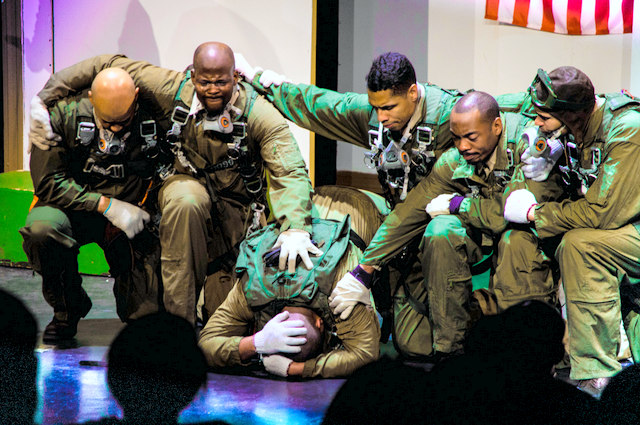
As an African-American actor struggling to find roles that spoke to his culture, Gray (now in his early 40s) became inspired to create a stage drama telling the story of the black aviators who overcame prejudice to become a vital part of the United States’ air campaign during World War II. After years of research, Gray developed “Black Angels Over Tuskegee,” a hour show that will enjoy a weekend run at The National World War II Museum’s Stage Door Canteen.

Debuting in Los Angeles in 2009 before a jump to off-Broadway in 2010, the show follows the story of six aviators who join the U.S. Air Force during both World War II and the height of the Jim Crow era of segregation.

Gray is quick to point out that this came at a time when mainstream America accepted research that suggested blacks were inherently inferior to whites — especially in terms of intellectual capacity. Basing his narrative on research but also interviews with several surviving airman, Gray hopes to present a story that not only inspires in showing how the airmen overcame these odds, but also the bonds they built while serving their country.

“When I interviewed one of the veterans, he didn’t talk about the medals he’d won but the friendships he made behind closed doors,” said Gray, who graduated from what is now the University of Louisiana at Lafayette. “I wanted to find a story that was organic and from the heart. We do this show for kids a lot, and I always stress that we as African Americans have no reason not to succeed. This was at a time when they were considered less than men.

“If they could take all that and still fight for their country, then we have no reason not to succeed today,” Gray continued. “I want to tell young men that everyone should be accountable for themselves and be responsible for their own success.”

“Be a New Orleanian” remount helps Jim Fitzmorris put a fuzzy idea in sharper focus


INFO:
Be New Orleanian: A Swearing In Ceremony” (presented by Dirty Coast)
Written and performed by Jim Fitzmorris, directed by Mike Harkins
8 p.m. Thurs.-Sat., 6 p.m. Sun., through March 6
The Theatre at St. Claude, 2240 St. Claude Ave.
Tickets $20; call (504) 638-6326 or visit the website

NOTE: The final performance is 6 p.m. Sunday, March 6.

It’s only fitting that Jim Fitzmorris’ brilliant “Be a New Orleanian” one-man show now comes in booklet form, courtesy Dirty Coast. After all, Fitzmorris’ treatise on what makes one a citizen of the Big Easy — especially in the post-Katrina world of “New New Orleans” — is an instructional manual as much as it is a manifesto.

But it’s also because of Fitzmorris himself. Arguably the city’s most important playwright expounding on the city itself, Fitzmorris as both writer and performer comes at his audience with machine-gun ferocity, spitting out paragraphs of parables. In verbal form, at times they feel almost free of punctuation. He knows how to pack a lot of insight, humor and reflection in his one-hour show currently enjoying a remount at his new Theatre at St. Claude space (the old Marigny Theatre) behind the AllWays Lounge on St. Claude Avenue.

He premiered the piece in time for the 10-year anniversary of Katrina last August, which was fitting for many and garnered great reviews from NOLA.com | The Times-Picayune’s Ted Mahne and Gambit’s Tyler Gillespie. As someone who’d already burned out of both reading and creating 10th anniversary stories (and already filled with anxieties that a couple weeks later came home to roost), I’d consciously avoided anything with a whiff of the flood, and while I felt a twinge of regret at the time, I’d argue that now is an even better time to see this show. The show crystallizes every conflicting emotion about living in New Orleans … and, in my case, returning to New Orleans, for better and worse.

New Orleans now enters its even more uncertain post-post-Katrina period, one in which the recovery money and tax incentives are starting to dwindle, the media’s packed up its vans, and legacy of a Bobby Jindal governorship suggests a looming recession. If you want stormy weather, the city might be heading into it once again, and so Fitzmorris’ perspective is needed more than ever.

As other reviewers have astutely pointed out, Fitzmorris, despite possessing a razor-sharp wit, often has a bark worse than his bite. He can be pointed in his criticism and blunt in his tone, but “Be a New Orleanian” (subtitled “A Swearing In Ceremony”) is as much a love letter to his hometown as it is a cautionary to those who think they “get” the city but don’t, and maybe never will. Maybe that’s because Fitzmorris, like many, have tired of the vitriol aimed at the carpetbaggers and gentrifiers and going-native types who have flooded the city since the flood. In a city filled with so much love, why hate?

It’s cleverly structured around six basic tips, starting with the most timely in which he clearly distinguishes between the actual New Orleans and “N’Awlins,” with all its post-K perils, and divided into two suburbs: “Sadsaxophoneville” and “Spookyvoodooland.” The former suburb is what hit me right in the gut and the funny bone:

This is the place that provides generic N’Awlins background music for NPR. It is a particular favorite for the sort of people who consider Ira Glass, Terry Gross and Garrison Keillor as their holy trinity. When you step into Sadsaxophoneland, you will see an old saxophone player under a street lamp playing a soulful tune and occasionally stopping to say even more soulful things like … ‘Once you get inside N’Awlins, N’Awlins gets inside of you.”

Then there’s Spookyvoodland, which is just as rife with cliché:

Spookyvoodland has Congo Drums, and Skeleton Keys, and Angel Hearts, and moon glowed cities of the dead, and endless nights, and fortune tellers, and psychics whose gifts have driven them so mad they choose to help honeymooners from Scranton, Pennsylvania rather than play the stock market … Spookyvoodooland is filled with anyone who has ever sharpened their teeth and gone looking for a front row seat for the 15-round battle between the top-hatted Papa Laba and The Lou Garou in a loser-leave-town match.”

For sure, “Be a New Orleanian” suggests at times a New Orleans culture — however defined — under siege, and some of Fitzmorris’ anecdotes ring true to the teller. He delivers them on a spare stage, often getting up from behind his table (surrounded by New Orleans trinkets and iconography) to tell his stories. In pointing out the “New Orleans Linger,” he conjures the story of a Dorignac’s cashier who takes her sweet time ringing up two polar-opposite customers. One’s an aging, sweet-natured local who’s happier to chat than get through the line, and the one (behind her) is an impatient hipster rolling his eyes at the pair’s extended exchange. The cashier sizes up the temperament of both, and takes her sweet time checking out both customers — one out of love, the other out of spite.

“(I)f you take the linger out of New Orleans, you take its smile along with it,” he says. “And you turn us into a version of Atlanta with better food and more mosquitos.”

As someone who lived for seven years in Atlanta after moving from New Orleans, only to return a couple years ago, I felt that familiar twinge of defensiveness about living in the Crescent City’s favorite rival city and punching bag. The Atlanta I came to know and ultimately appreciate is a little better than perceived from a distance, but, really, its only crime was not being New Orleans. Whether driving around the city or interviewing New Orleans authors I’d coaxed to the Decatur Book Festival, I’d kept near me that sliver of a bumper sticker that read, “Be a New Orleanian. Wherever You Are.” For seven years, I knew what it means to miss New Orleans.

But the return to the city, despite years of visits back with friends and family and familiar and new spots, felt like a crash landing and at times felt like a strange new world all over again. I wondered, for a second time, if I had any right to call myself a New Orleanian. It reminded me of a commentary I’d penned for Gambit (Weekly, thank you) when I was the managing editor after Katrina, titled “So Long … For Now.” Among other things, I pondered what effect staying to help rebuild the city would affect us as others left, not realizing at the time I would fit in both categories:

I’ve often thought about how, because of New Orleans’ sometimes provincial nature — where natives are polite but sometimes leery of transplants — non-natives have to qualify for special pins to mark the time they’ve put in here. You know, like Alcoholics Anonymous members. Now, I fear another caste system is already developing. Those who stayed through the storms will be the proudest, followed by those who returned within days, then within weeks, and then months. And we will all revel in our pride for being the brave frontier folk who stayed to fight the good fight, to rebuild the city. And then, when our friends return, when the city is in better shape — when the stink blows away, the debris clears up, the services return to normal, even homes become inhabitable — we’ll resent them.”

But in “Be a New Orleanian,” Fitzmorris takes complex emotions like these and remains gleefully positive. His basic point: If you come here and try to make New Orleans a better place without taking away that which makes it unique, you will fit in just fine.

The show ends with the suggested swearing-in ceremony. I’d planned not to participate, partly out of a critic’s objectivity, partly out of desire not to seem presumptuous or pretentious. But as everybody else in the audience rose, I couldn’t help but join in the fun.

Now it’s official. The bumper sticker is now a book, and a way of life. Thanks, Jim.

The Theatre at St. Claude releases 2016 spring-summer season schedule

This slideshow requires JavaScript.

The Theatre at St. Claude, the new theater launched by brothers Jim and Ryan Fitzmorris, announced a diverse lineup of shows for its spring and summer season for 2016 in a party held at the venue on St. Claude Avenue.

“It is one that lives up to its mission statement of presenting plays that revel in the whisper of conspiracy, delight in a collective gasp, and enjoy a taste for the curious oddity,” the theater said in a press release. “We hope you agree that this collection of new works, challenging plays and alternative programming proves we are New Orleans’ premiere venue for the wild, weird, and wondrous.”

In addition to the regular schedule, the theater also will host other shows such as Southern Rep’s 6×6, 3×3, and Pat Bourgeois’ “Debauchery.”

Below is the complete schedule with descriptions provided by the theater:

  1. “Be A New Orleanian: A Swearing in Ceremony (Presented By Dirty Coast)” by Jim Fitzmorris (Thursday through Saturday, from Feb. 12 through Feb. 28 with a bonus show on Monday, Feb 29.)
  2. Irish Voices including Samuel Beckett’s “Not I” (Thursday through Saturday, from March 10 through March 19.)
  3. Tennessee Williams Fest
  4. Jazz Fest
  5. Strange For Hire Presents “Sideshow and Tell” (Friday through Sunday, from May 13 through May 15.)
  6. “Would Jesus Thank God It’s Friday” by Paul Oswell (Friday through Sunday, from May 27 through May 29.)
  7. “Barker’s Edge of Town” by Bradley Warshauer and “The New Wave” by Stephanie Garrison Warshauer (Thursday through Saturday, from June 10 through June 19.)
  8. “The Killing of a Lesbian Bookie” by Jim Fitzmorris (Thursday through Saturday, from June 23 through July 9.)
  9. Halloween in July (Thursday through Saturday, from July 14 through July 16.)
  10. “Niagara Falls” by Justin Maxwell (Thursday through Saturday, from July 21 through Aug. 6.)
  11. “On the Verge” by Eric Overmyer (Thursday through Saturday, from Aug 11 through Aug 27.)

“Be A New Orleanian: A Swearing in Ceremony (Presented By Dirty Coast)” by Jim Fitzmorris: Just in time to help with those post-Mardi Gras blues, the hit monologue returns for a month-long run.

“Be A New Orleanian” is a wild, comic ride through what it takes to call yourself a citizen of the Crescent City. History, heartbreak, and celebration are all part of an evening from a performer/writer The Times-Picayune calls “electric.”

Thursday through Saturday, from Feb. 12 through Feb. 28 with a bonus show on Monday Feb 29.

Opening night to feature a book signing party of “Be A New Orleanian” from Dirty Coast.

Irish Voices including Samuel Beckett’s “Not I”: It wouldn’t be St. Patrick’s Day without a few tales of melancholy, blarney and ebullience. Works of Samuel Beckett and W. B. Yeats are included in this evening of monologues featuring Kathleen McManus, Margeaux Fanning, and Blaise Lanigan.

Thursday through Saturday, from March 10 through March 19.

Tennessee Williams Fest: We will soon be announcing a series of theatrical events, ranging from the serious to the uproarious to the outright risqué, all in celebration of arguably America’s greatest playwright.

March/April: Check for dates.

Jazz Fest: “Chapter:SOUL “presents two weekends worth of after-hours musical programming guaranteed to blow the roof off and knock you through the back wall.

April/May: Check for dates.

Strange For Hire Presents “Sideshow and Tell”: Coney Island veterans Donny Vomit and Frankie Sin introduce New Orleans to their own unique version of the strange and wondrous with a full evening of acts, stories, and sexy turns.

Friday through Sunday, from May 13th through May 15th.

“Would Jesus Thank God It’s Friday” by Paul Oswell: A freelance journalist and sometime comedian, Paul Oswell brings his latest theatrical offering to The Theatre at St. Claude.

Born in the UK, Oswell has lived in New Orleans since 2010 and currently hosts two weekly comedy shows: Local Uproar and Night Church. He has written and performed several one-man shows which were featured in the New Orleans Fringe Festival, including “An Englishman in New Orleans”, “A Britsummer Night’s Dream”, “This Rhyme It’s Personal” and “Narrowing My Horizons”.

Friday through Sunday, from May 27 through May 29.

“Barker’s Edge of Town” by Bradley Warshauer and “The New Wave” by Stephanie Garrison Warshauer: Bradley and Steph Warshauer will take audiences to the shadowy tip of nowhere with a double feature of original plays set in worlds unlike our own but strangely familiar.

Thursday through Saturday, from June 10 through June 19.

“The Killing of A Lesbian Bookie” by Jim Fitzmorris: On the eve of her nightclub’s opening, burlesque dancer Triple Lexxx receives a visit from a stranger who is more than he first appears. His arrival jeopardizes her relationship, her career, and…maybe her life. Jim Fitzmorris’ “The Killing of a Lesbian Bookie” takes place in a world where romance and commitment are nothing more than the flip side of violence and vengeance.

Starring Lin Gathright, Justin Welborn and Kimberly Kaye.

Thursday through Saturday, from June 23 through July 9.

Halloween in July: Why should Christmas have all the fun? Pandora Gastelum and Jim Fitzmorris will ask the interactive question, “Is There A Good Movie Buried Inside Halloween III?”

And if that doesn’t pique your interest, then just join us for the “Halloween in July” party on July 16.

Thursday through Saturday, from July 14 through July 16.

“Niagara Falls” by Justin Maxwell: One of New Orleans’ leading playwrights, Justin Maxwell (“An Outopia For Pigeons”) takes us down a waterfall of language with his world premiere “Niagara Falls”. Though set in upstate New York, this tale of ghosts, political corruption, and deep longing will undoubtably resonate with New Orleans viewers.

As an added bonus, the three week run will include readings of Maxwell’s shorter works and a panel discussion on the state of playwriting in New Orleans.

Thursday through Saturday, from July 21 through Aug. 6.

“On the Verge” by Eric Overmyer: Our spring/summer season ends with one of the most popular language plays of all time. Eric Overmyer’s delightful delirium of words is about three female Victorian explorers who make their way into the mysterious Terra Incognito. Overcoming great obstacles, they leap forward through space and time into a world full of yearning and possibilities.

Co-produced with Rebecca Frank’s In Good Company, “On The Verge: The Geography of Yearning” will be directed by Frank.

Thursday through Saturday, from Aug. 11 through Aug. 27.

Interview with David Simon and Eric Overmyer – Treme from Peabody Awards on Vimeo.